Click here to buy secure, speedy, and reliable Web hosting, Cloud hosting, Agency hosting, VPS hosting, Website builder, Business email, Reach email marketing at 20% discount from our Gold Partner Hostinger You can also read 12 Top Reasons to Choose Hostinger’s Best Web Hosting
If you compare GoHighLevel vs HubSpot, it comes up with a lot of comparable features – especially when agencies or SMBs want powerful marketing automation and a CRM that actually pays for itself. Both platforms are solid, but they target different users and buying models. Below I cut through the marketing noise with a clear, practical comparison so you can pick the right tool for your specific needs.
I use vendor docs and recent comparisons as the basis for facts and pricing.
Quick verdict
Choose GoHighLevel if you’re an agency or consultant who wants an all-in-one, white-labelable platform that replaces multiple tools at a predictable monthly price.
Choose HubSpot if you want a polished, extensible CRM with a generous free tier, deep integrations and enterprise-grade marketing & service hubs — and you’re prepared to pay more as you scale.
Headline differences: positioning & who they serve
GoHighLevel
Built for agencies and marketing shops that want to manage multiple clients, white-label the product, and centralize funnels, SMS, email, CRM and appointment flows. It’s “agency-first” and priced per account model rather than per-seat enterprise fees.
HubSpot
Built as a customer platform for marketing, sales and service teams. It’s strong on integrations, UI polish, developer ecosystem and an extensible free CRM that grows into paid hubs (Starter → Professional → Enterprise). Great fit for businesses that want a platform to scale and don’t mind paying for advanced features.
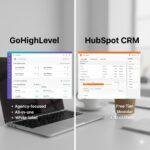
GoHighLevel vs Hubspot CRM: Comparison for Small Businesses
Pricing snapshot
GoHighLevel (high-level summary)
(Ad)

Plans: Starter — $97/mo, Unlimited — $297/mo, Agency Pro / SaaS — $497/mo (these include sub-accounts and agency features). Good value if you manage many clients or want white-label SaaS mode.
HubSpot (high-level summary)
HubSpot offers a free CRM with useful core features. Paid tiers vary by hub: Starter (around $20+/mo for basic bundles), Professional and Enterprise rise quickly (hundreds to thousands per month depending on seats and hubs). HubSpot is per-seat / per-hub pricing and can be more expensive as you add users and features.
What it means: GoHighLevel gives predictable agency-friendly pricing that can be cheaper per client. HubSpot’s free tier is powerful for small teams, but the cost of advanced marketing automation, analytics and enterprise features scales up quickly.

Feature face-off
CRM & Contacts
HubSpot: Best-in-class free CRM, contact/lead management, contact insights and built-in reporting. Excellent for sales teams who need reliable deal pipelines and deep integrations (email, meetings, docs).
GoHighLevel: CRM focused on lead capture + agency workflows, strong for pipeline automation across clients but less deep on native analytics and marketplace integrations than HubSpot.
Marketing automation & funnels
GoHighLevel: Funnels, landing pages, SMS + email sequences, voicemail drops, and multi-channel campaign automation all built in — designed to replace multiple marketing tools. Great for rapid campaign launches without stitching services.
HubSpot: Powerful automation builder with advanced segmentation, attribution, and reporting. Better for content-led inbound marketing and multi-touch attribution at scale — but often relies on paid hubs.
Agency features & white-label
GoHighLevel: Core strength — white-label SaaS mode, client sub-accounts and re-billing capabilities. If you want to resell a branded product to clients, GoHighLevel is purpose-built.
HubSpot: Offers partner programs and resell options but is not focused on white-label SaaS the way HighLevel is. HubSpot partners typically resell services, integration and implementation rather than a white-label product.
HubSpot Marketing Starter Hub Website Pages Examples
Integrations & ecosystem
HubSpot: Winner here — large app marketplace, native integrations with major tools, strong APIs, and enterprise connectors. If your stack needs lots of third-party apps, HubSpot integrates broadly.
GoHighLevel: Integrations exist (Zapier, APIs) but the platform’s pitch is to replace many tools — fewer third-party native integrations than HubSpot.
Support, onboarding & maturity
HubSpot: Mature onboarding, training academy, certified partners and enterprise support. Better documentation and predictable enterprise SLAs.
GoHighLevel: Active community, agency-focused playbooks, and faster product iteration. Onboarding is often community/partner-driven; enterprise-grade support varies by plan.
7 Easy Steps to Create a Free Business Website with HubSpot
Who should choose which — real use cases
Pick GoHighLevel if:
You run a marketing/SEO/design agency and want a single platform to build, host and bill clients.
You want white-label capability and predictable monthly pricing for unlimited client sub-accounts.
You want an all-in-one stack (funnels, SMS, CRM, booking) without stitching many SaaS apps.
Pick HubSpot if:
You need a robust free CRM that scales into advanced marketing, sales and service hubs.
Your business relies on many third-party tools and needs deep integrations and enterprise reporting.
You want best-in-class onboarding, partner ecosystem and long-term product maturity for large teams.
Migration & implementation notes
Migrating from other CRMs into HubSpot is straightforward with built-in importers and many partner tools; expect per-user onboarding and integration work for paid hubs.
GoHighLevel migration is common for agencies moving from a patchwork of funnel and comms tools — it often requires rebuilding funnels and automations but reduces tool sprawl afterward. Plan for time to reconfigure client automations and phone/SMS routing.
Pros & cons
GoHighLevel
Pros: Agency / white-label features, predictable pricing for agencies, integrated funnels + SMS + CRM.
Cons: Fewer native third-party integrations, steeper learning curve for non-agency teams, some enterprise features missing.
HubSpot
Pros: Free CRM, rich integrations, polished UX, strong analytics and partner ecosystem.
Cons: Can become expensive as you add seats and hubs; agencies reselling often find margins squeezed by per-seat pricing.
Decision checklist — pick your winner in 60 seconds
Do you need white-label SaaS & client re-billing? → GoHighLevel.
Do you want the best free CRM + deep integrations? → HubSpot.
Are you building long-term enterprise reporting & custom integrations? → HubSpot.
Are you an agency replacing many small tools and want fixed costs? → GoHighLevel.
How to Automate Sales and Save 10 Hours/Week with HubSpot CRM Hacks for Small Businesses (Free Template Inside)
FAQs (short & copy-paste)
Q: Is GoHighLevel better than HubSpot?
A: “Better” depends on use case. For agencies and white-label SaaS, GoHighLevel often wins on price and all-in-one functionality. For businesses needing a mature CRM, integrations and enterprise analytics, HubSpot is usually the better choice.
Q: Which is cheaper — GoHighLevel or HubSpot?
A: For agency-style unlimited client sub-accounts, GoHighLevel’s plans (e.g., $97–$497/mo tiers) are often cheaper and more predictable. HubSpot’s free CRM is free to start, but paid hubs and seats can become costly as you scale.
Q: Can I white-label HubSpot?
A: HubSpot has partner programs, but it’s not designed to be a white-label SaaS product the way GoHighLevel is. HubSpot partners typically resell services rather than a white-label product.
Q: Do both platforms have AI features?
A: Yes — both have AI features in 2026. HubSpot focuses AI on content suggestions, predictive scoring and analytics. GoHighLevel emphasizes automation and agent-style tools for agencies. Feature depth varies by plan.
Final takeaway
If you’re an agency or reseller who wants to own the client relationship and brand, GoHighLevel is purpose-built and cost-effective. If you’re a growing business that values integrations, polished CRM functionality, and enterprise-grade reporting, HubSpot is the safer long-term bet — if you budget for it.
Now loading...