Click here to buy secure, speedy, and reliable Web hosting, Cloud hosting, Agency hosting, VPS hosting, Website builder, Business email, Reach email marketing at 20% discount from our Gold Partner Hostinger You can also read 12 Top Reasons to Choose Hostinger’s Best Web Hosting
Confused about agentic AI vs generative AI? Learn the difference, real examples, when to use each, risks, and practical tips to pick the right approach for your project.
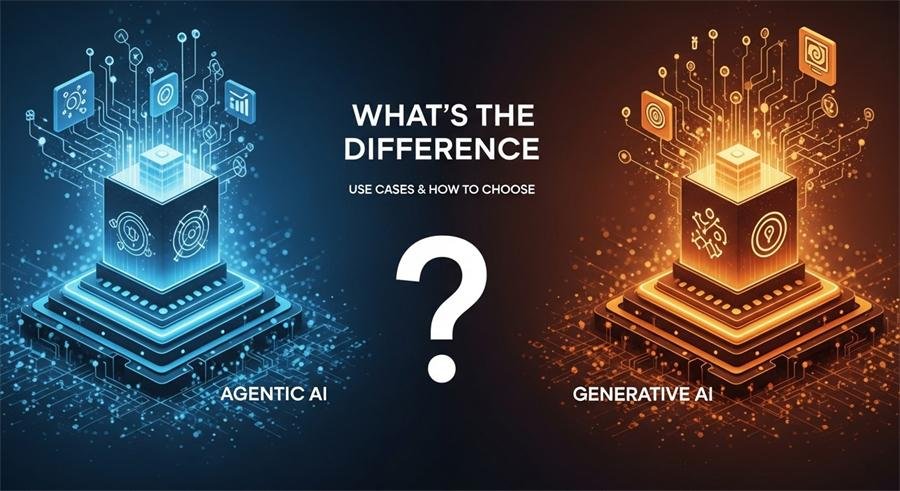
Generative AI creates content (text, images, audio) from prompts — think chatbots or image models. Agentic AI goes further: it sets goals, plans multi-step actions, uses tools, and takes (semi-)autonomous actions to achieve outcomes. Use generative AI for one-shot creative tasks; use agentic AI when you need an automated workflow that can research, act, and iterate with minimal human hand-holding.
Create inspirational images from the top AI generators. Simply enter a subject, They’ll apply styles, and you’ll tweak the one you like.
Why this matters
People often use the terms interchangeably, but the difference matters for design, trust, and safety. If you treat a generative model like an agent (let it act on your systems), you risk unexpected behavior. Conversely, if you treat an agent like a simple generator, you miss out on automation gains. Knowing what each is helps you choose the right architecture and the right guardrails.
Definitions — plain and practical
Generative AI
Generative AI models produce new content from a prompt: text, images, audio, code. Examples: large language models that write blog drafts, image models that generate marketing visuals, or audio models that synthesize speech. Key attribute: output-on-request. It answers, translates, or creates, but it doesn’t necessarily plan multi-step actions or operate tools by itself.
Agentic AI
Agentic AI (or “agents”) is a system that takes goal-directed actions over time. An agent will: accept a goal, break it into steps, call external tools (APIs, search, databases), evaluate results, and iterate until the goal is reached or it stops. Key attribute: autonomy + planning + tool use. Agents are built by combining generative capabilities with orchestration logic, memory, and tool integrations.
(Ad)

Side-by-side comparison
| Characteristic | Generative AI | Agentic AI |
|---|---|---|
| Primary job | Create content from prompts | Achieve goals via multi-step actions |
| Typical output | Text, images, audio, code | Actions: API calls, file edits, emails, follow-ups |
| Interaction model | Request → Response | Goal → Plan → Act → Evaluate → Iterate |
| Human role | Reviewer/editor | Supervisor / exception handler |
| Best for | Content creation, rewriting, brainstorming | Automation, research agents, workflow orchestration |
| Risk profile | Hallucinations, bias | Unintended actions, security, runaway loops |
Concrete examples (so it’s not abstract)
Generative AI examples
A model that writes a product description from a short brief.
An image generator that makes hero images for blog posts.
A speech model that converts text to podcast-ready audio.
Agentic AI examples
An agent that: (1) searches the web for competitor pricing, (2) compiles a spreadsheet, (3) emails the results to you, and (4) schedules a follow-up meeting.
An automation that monitors servers, triages alerts, attempts a safe restart, and notifies the on-call engineer if problem persists.
A recruiting agent that screens resumes, schedules interviews, and follows up with candidates automatically.
When to use which
Use generative AI when you want:
Fast drafts, creative variations, or single-turn outputs.
Assistance that stays in the sandbox until a human decides to act (e.g., content, ad copy, image concepts).
Use agentic AI when you want:
Tasks that require multiple steps, tool usage, or cross-system workflow (research + update CRM + notify team).
Repetitive, rules-driven processes that benefit from automation and conditional logic.
I usually start with generative models to prototype an agent’s “brain” (the prompts and reasoning) — then add orchestration and tool access when automation is justified.
8 Specialized Grammarly AI Agents Tools That Turn Proofreading into a Full Writing Workflow
Design patterns — how they’re built
Generative-only workflow (simple):
User prompt → LLM generates text/image → human edits → publish.
Agentic workflow (multi-layer):
User sets a goal.
Planner breaks the goal into tasks.
Executor calls tools (search, APIs, DB).
Evaluator checks results and decides next step.
Loop until success or stop condition.
Log actions, raise for human review if needed.
Common agent architectures use an LLM for planning and reasoning, plus a tool registry and an execution controller (often implemented with frameworks like LangChain or custom orchestrators).
Benefits & trade-offs
Generative AI — benefits
Fast, cheap prototyping.
High creativity and variety.
Easy to control (single-turn prompts).
Generative AI — trade-offs
Outputs need review; hallucinations are common.
Not designed to act on systems securely by default.
Agentic AI — benefits
Automates multi-step work and reduces repetitive tasks.
Can combine data, tools, and logic for outcomes rather than just outputs.
Agentic AI — trade-offs
Higher complexity and engineering cost.
Greater safety and security risks (must protect APIs, credentials and enforce rules).
Harder to audit unless you log thoroughly.
Security Alert: Why Experts Are Urging You to Block AI Browsers Immediately
Safety & governance — practical guardrails
If you plan to add agency (let systems act), do these first:
Principle of least privilege: Give agents only the tools and permissions they absolutely need.
Human-in-the-loop: Require explicit review for high-impact actions (payments, deletions, legal messages).
Action logging & explainability: Log plans, tool calls, and decisions for audits. Keep an explainable transcript.
Rate limiting & kill switches: Prevent runaway agents and provide emergency stop controls.
Validation and sandboxing: Test agents in isolated environments before production.
Input validation: Validate and sanitize any data agents use when calling external systems.
I always recommend starting with manual review for the first 100 runs of any agent before switching to more autonomy.
ChatGPT 5 vs Claude vs Gemini vs Grok vs DeepSeek — Choosing the Right AI for the Right Task
Quick checklist to pick a path for your project
Is the task one-off content? → Use generative AI.
Does the task need tool use or multiple steps? → Consider building an agent.
Is the task high risk (money, user data, automatic deletion)? → Add human-in-the-loop and strict permissions.
Do you have access to developer resources to monitor and maintain the system? → Agentic AI may be worth the ROI.
Example prompt patterns
Generative prompt (content):
Write a 300-word product description for a compact travel tripod. Use friendly tone, include 3 features and a short CTA.
Agent planning prompt (for an agent’s planner):
Goal: Find three recent blog posts on “remote work productivity” with data points to cite. Plan these steps: 1) search web and collect URLs, 2) extract three key data points from each, 3) compile CSV with title, URL, data point, timestamp. If any source is paywalled, skip and log warning.
Common mistakes to avoid
Giving agents broad credentials (e.g., full admin tokens) during development.
Trusting raw model outputs for critical decisions (no human verification).
Confusing fancy prompt engineering with system design — building a reliable agent needs engineering, not just clever prompts.
Is ChatGPT an AI Agent? Understanding Its Capabilities and Use Cases
FAQs
Q: Can a generative model become an agent if I give it code access?
A: You can wrap a generative model in orchestration code to build an agent. The model powers reasoning; the orchestrator controls actions and limits. The result is an agentic system, not a raw generative model.
Q: Are agents the same as “AI assistants”?
A: Not always. An assistant can be generative (chat-only) or agentic (can act on your systems). “Agentic” emphasizes autonomy and tool use.
Q: Which is riskier — generative or agentic?
A: Agentic systems carry higher operational risk because they can act and cause changes. Generative systems mainly carry reputational or misinformation risk.
OpenAI Unveils ChatGPT AI Agent that Works for You to Automate Complex Tasks
Final takeaway
Generative AI and agentic AI are related but different tools in your toolkit. Generative models are brilliant at creating and ideating; agentic systems are about getting work done—autonomously and end-to-end. Start with generative prototypes, harden the prompts and tests, and only add agency when you’ve proven the logic and set strong safety controls.
Now loading...