Click here to buy secure, speedy, and reliable Web hosting, Cloud hosting, Agency hosting, VPS hosting, Website builder, Business email, Reach email marketing at 20% discount from our Gold Partner Hostinger You can also read 12 Top Reasons to Choose Hostinger’s Best Web Hosting
Knowing how to write a guest post pitch that actually gets accepted is the problem most content guides skip over completely. They tell you what guest posting is, why it matters for SEO, and then hand you a generic email template that every editor on the planet has already seen 200 times this month.
This guide is different. It covers the full picture from both sides of the desk — what writers do wrong when pitching, what editors are actually looking for when they open a pitch email, how to find sites worth pitching (including SmashingApps), and three pitch email templates you can adapt today. If you are a writer looking for guest post opportunities on design, developer, and tech productivity blogs, this guide was written with you specifically in mind.
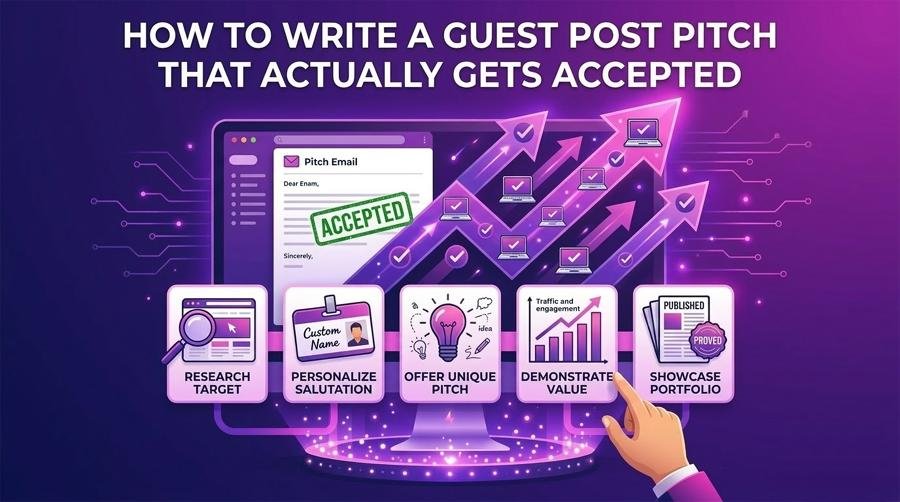
Why Guest Posting Still Works in 2026 — And Why Most People Do It Wrong
Guest posting is one of the oldest content marketing strategies on the internet, and in 2026 it remains genuinely effective — for three reasons that have nothing to do with the generic SEO talking points most guides lead with.
First: Borrowed audience trust. When you publish on a site that already has a loyal readership, you inherit a portion of that trust immediately. A reader who has followed SmashingApps for three years and consistently found the content reliable will extend that trust to a guest writer published there — without requiring you to have built your own audience first.
Second: Real referral traffic. A guest post on a relevant site in your niche continues to drive referral clicks for months and years after publication — as long as the site keeps it indexed. Unlike social posts that fade in 48 hours, a well-placed guest post is a permanent traffic asset.
(Ad)

Third: Topical authority signals. When a quality site in your niche links back to your site from a guest post, Google reads it as a topical authority signal — someone in your field vouches for your expertise. This is qualitatively different from directory links or link exchanges.
Why Most People Do It Wrong
The problem is not the strategy. The problem is execution. Guest posting done wrong means:
- Sending mass template emails to 50 sites with zero personalization
- Pitching topics that are completely irrelevant to the site’s audience
- Writing posts that are thinly-veiled advertisements for your own product or service
- Submitting content that would not pass your own editorial standards
- Ignoring published submission guidelines entirely
Done wrong, guest posting wastes your time, annoys editors, and earns you a permanent place in the spam filter. Done right, a single guest post on the right site can drive hundreds of qualified visitors, earn a high-quality backlink, and open an ongoing contributor relationship worth far more than any single placement.
Lifestyle Guest Posting Sites – 15 Places That Still Accept Pitches (and how to get accepted)
The 7 Reasons Guest Post Pitches Get Rejected — From an Editor’s Perspective
Before you write a single word of your pitch, understand what happens on the other side of the inbox. Sites that publish guest content regularly receive anywhere from 20 to 200 pitch emails per week. Most are rejected within 10 seconds of opening. Here is exactly why.
1. It Is Obviously a Template
The most common reason for immediate rejection: the email is clearly a mass outreach template with a name-field filled in. Phrases like “I’ve been a long-time reader of your excellent blog” paired with a pitch that is completely generic signal immediately that the writer has never actually read the site. Editors recognize template emails on sight. Personalization is not optional — it is the minimum barrier to entry.
2. The Topic Has Already Been Covered
Pitching a topic the site published three months ago — or six variations of — is one of the fastest ways to get rejected. It signals you did not do basic research. Before pitching any topic, search the site for your idea. If a version of it already exists, either find a meaningfully different angle or move on to a different topic.
3. The Topic Is Off-Audience
A site that publishes content for designers, developers, and freelancers using digital tools does not want a guest post about real estate investing, general wellness, or cryptocurrency speculation — regardless of how well-written it is. Relevance to the existing readership is non-negotiable. The fastest way to confirm relevance: would the existing readers of this site find this post genuinely useful? If the honest answer is no, do not pitch it.
4. The Content Quality Signal Is Low
Editors judge your pitch quality as a proxy for your writing quality. A pitch with spelling errors, vague topic descriptions, and no evidence of research signals that the final article will be the same. A pitch that references specific recent posts on the site, proposes a clear angle with a specific audience benefit, and includes links to strong existing writing samples does the opposite.
5. It Is Promotional Content in Disguise
Guest posts that exist primarily to promote the writer’s own SaaS tool, agency, or service are rejected universally by quality editorial sites. If the only reason for the article to exist is to insert links to your product, editors will recognize it. The distinction is clear: does the article genuinely help the reader, or does it exist to sell something? Genuine help first — any mention of your own work should be incidental to a post that stands on its own merits.
6. No Writing Samples
Asking an editor to accept a guest post without providing any evidence of your writing quality puts the entire risk on them. Always include 2–3 links to your best existing published work — your own blog posts, previous guest posts, or published articles anywhere. If you have no published work, say so honestly and submit a sample piece or detailed outline instead. Zero evidence of writing ability is a reliable rejection trigger.
7. The Pitch Is Too Long or Too Short
A pitch email should be scannable in 90 seconds. Anything requiring more than three minutes to read is too long — editors do not have time for essays in their inbox. Anything shorter than a clear topic, a one-paragraph description of the angle, and a brief introduction of yourself is too thin to evaluate. Two to four short paragraphs is the reliable sweet spot.
What is Guest Posting in SEO and 20 Free Guest Posting Sites List
How to Find Guest Post Opportunities Worth Pursuing
Not every site that accepts guest posts is worth your time. Here is a practical framework for finding sites where a guest post will actually move the needle.
Step 1 — Start With Audience Alignment, Not Domain Authority
The most common mistake in finding guest post opportunities is filtering by domain authority first. Domain authority matters — but only if the site’s audience overlaps with yours. A guest post on a DR 80 site whose readers have zero interest in your niche earns a backlink and almost no referral traffic or audience exposure. A guest post on a DR 40 site whose readers are exactly your target audience earns less SEO authority but significantly more real business value.
Filter for audience alignment first. Domain authority second.
Step 2 — Use Search Operators to Find Accepting Sites
The fastest way to find sites actively accepting guest posts in your niche:
Search Google for these queries — replace [your niche] with your specific category:
[your niche] "write for us"[your niche] "guest post guidelines"[your niche] "submit a guest post"[your niche] "contributor guidelines"[your niche] "become a contributor"
For designers, developers, and tech freelancers specifically: – "design blog" "write for us" 2026 – "developer tools" "guest post guidelines" – "productivity tools" "contribute an article" – "freelance" "design" "submit a post"
Step 3 — Check Competitor Backlink Profiles
If a site in your niche has published guest posts, their competitors probably accept them too. Use a free backlink checker (Ahrefs’ free tier, Moz Link Explorer free account) to look at a competitor’s backlink profile and filter for links from editorial sites. Sites that have linked to your competitors from guest posts are warm targets — they have already demonstrated willingness to publish guest content in your niche.
How to Post a Guest Column on Money.com
Step 4 — Look for Active Editorial Communities
Editors and content managers at tech and design publications regularly post on LinkedIn and X/Twitter asking for contributors on specific topics. Following editors at publications you want to write for — and monitoring those feeds — means you will sometimes see explicit calls for pitches before the general writer community does.
Reddit communities including r/blogging, r/SEO, and niche-specific subreddits for design and development regularly share guest post opportunities and submission calls.
Step 5 — Prioritize Quality Over Quantity
Five carefully researched, genuinely personalized pitches to the right sites will produce better results than 50 template emails sent to the wrong ones. Set a realistic target: identify 10 sites that genuinely match your audience and expertise, research each one thoroughly, and pitch them with real personalization. This approach has a meaningfully higher acceptance rate than mass outreach.
How to Find Write for Us Websites for Guest Posts
How to Write a Guest Post Pitch That Gets Accepted — Step by Step
Step 1 — Read the Site Thoroughly Before Writing Anything
This is the step most writers skip because it takes time. It is also the step that separates accepted pitches from rejected ones. Before writing a word of your pitch:
- Read at least 5 recent posts on the site — not just headlines, the actual articles
- Note the writing style: formal or conversational, long-form or concise, data-heavy or example-driven
- Identify topics they cover regularly and topics they have never covered
- Look for content gaps — subjects their audience clearly cares about that the site has not addressed
- Read the published submission guidelines completely if they exist
Your pitch should demonstrate this research. Not by saying “I’ve done my research” — but by referencing specific posts, identifying a genuine content gap, and proposing a topic that fits the site’s existing pattern.
Step 2 — Find a Specific, Narrow Topic
A common pitch mistake: proposing a topic so broad it could apply to any blog anywhere.
Too broad: “I’d like to write about productivity tools for remote workers.”
Specific and pitchable: “I’d like to write ‘Why Most Freelancers Overpay for Project Management Software — And the 3 Free Alternatives That Cover 90% of the Same Features.’ Your recent post on ClickUp’s free plan changes suggests your readers are actively navigating this problem.”
The second version is specific, demonstrates site knowledge, identifies an audience pain point, proposes a clear benefit, and shows the writer has read recent content. It takes 10 minutes longer to write. It has a dramatically higher acceptance rate.
Step 3 — Write the Pitch Email
Subject line: Keep it direct and specific. The subject line is not the place for cleverness.
Good subject lines: – Guest post pitch: [specific proposed headline] – Contributor pitch for SmashingApps — [topic] – Article proposal: [proposed title] — [your name]
Avoid: “Question about your blog,” “Collaboration opportunity,” “Content partnership” — all of these signal template email before the body is even opened.
The email body — four sections:
① One sentence introduction. Who you are, what you write about, and one specific thing you appreciated about the site. Not “I’ve been a long-time reader.” Specific: “Your breakdown of ClickUp’s free plan limits was the most honest assessment I’ve read — most reviews gloss over the task limit reset issue entirely.”
② The pitch. Proposed headline, a 3–4 sentence description of the article’s angle, the specific reader problem it solves, and why it fits the site’s audience. This is the core of the email. Be specific about what the reader will learn.
③ Why you. Two to three sentences on your relevant expertise or experience — what makes you the right person to write this specific post. Not your general biography. Your relevant qualification for this specific topic.
④ Writing samples. Two to three links to your best relevant published work. If you write about design tools, link to posts about design tools — not your personal blog posts about your vacation. Relevance of samples matters.
Close with a clear, low-pressure next step: “Happy to send a full outline if this sounds like a fit.”
Link Insertion vs Guest Blog Posting: A Comparative Analysis
Three Pitch Email Templates — With Commentary
Template 1 — Standard Pitch for a Blog You Know Well
Subject: Guest post pitch: [Proposed Article Headline]
Hi [Editor’s name],
I’ve been following [Site Name] for a while — your recent post on [specific article] gave the clearest breakdown I’ve found on [specific topic the article covered]. It’s the kind of honest, practical take your readers clearly respond to.
I’d like to pitch an article for [Site Name]:
[Proposed headline]
[3–4 sentences: what the article covers, what specific problem it solves for the reader, why this topic fits the site’s existing content and audience. Be concrete — include the specific angle, not just the subject.]
I cover [your topic area] at [your site/publication]. Relevant recent work: [link 1], [link 2].
Happy to send a full outline if this sounds like a fit for [Site Name].
[Your name]
What makes this work: Opens with specific site knowledge (not flattery), leads immediately with the pitch, describes the article in terms of reader benefit (not self-promotion), provides writing evidence, closes with a low-pressure next step.
Template 2 — Pitch When You Have No Previous Guest Posts
Subject: Contributor pitch — [Proposed Headline] — [Your Name]
Hi [Editor’s name],
I write about [your topic] at [your site] and I’ve been a consistent reader of [Site Name] — particularly your coverage of [specific category the site covers well].
I have a specific article I think would work well for your audience:
[Proposed headline]
[3–4 sentences: the angle, the reader problem, why this fits the site’s existing coverage. Be specific and concrete.]
I haven’t published as a guest contributor before, but I write regularly at [your site] — here are two recent posts that reflect my style and depth: [link 1], [link 2]. I’ve also drafted an outline for this specific piece which I’m happy to share if it’s helpful for your evaluation.
[Your name]
What makes this work: Addresses the no-guest-post experience honestly rather than hiding it, substitutes an outline offer for sample guest posts, still demonstrates site knowledge and proposes a specific article.
Template 3 — Follow-Up After No Response (One Follow-Up Only)
Subject: Re: Guest post pitch — [Proposed Headline]
Hi [Editor’s name],
Following up briefly on the pitch I sent [X days] ago for [proposed headline]. Completely understand if it wasn’t the right fit — if that’s the case, no problem at all.
If you’re still considering it, I’m happy to share a full outline or adjust the angle if the topic direction would work better for your readers.
Either way, keep up the great work on [Site Name] — [one specific recent post] was particularly useful.
[Your name]
What makes this work: One follow-up only, low pressure, offers flexibility without desperation, closes graciously regardless of outcome.
Critical rule: One follow-up maximum. A second follow-up after no response is spam. Move on to your next target.
Write for SmashingApps — What We Are Looking For
SmashingApps publishes practical, honest content for designers, developers, and freelancers who work with digital tools every day. If you are a writer with genuine expertise in these areas, we welcome contributor pitches.
Topics We Cover and Want More Of
Our readers are working professionals — freelance designers, frontend developers, UX practitioners, digital marketers, and small business owners who use tools like Figma, Notion, ClickUp, Canva, VS Code, and web hosting platforms daily. The content they value most is:
- Honest tool comparisons — not sponsored roundups, but real assessments of free vs paid tiers, where tools fall short, and who each tool is actually right for
- Practical how-to guides — step-by-step tutorials for tools and workflows with real screenshots and specific examples, not generic overviews
- Free tool and resource roundups — genuinely free resources (see our criteria: no credit card required, no trial expiry) with honest free tier limitations stated clearly
- Productivity workflows — how working designers and developers actually use their tool stack, with specific setups and configuration recommendations
- News-triggered evergreen content — when a major tool changes pricing, launches a significant feature, or makes a move that affects our readers, practical guides that explain what it means and what to do
Topics We Do Not Accept
- Content that exists primarily to promote a specific product, service, or brand
- Generic “top 10 tools” lists without meaningful original analysis or honest assessment
- Content outside our core audience (general business advice, finance, health, lifestyle)
- AI-generated content submitted without substantial human editing and expertise
- Anything that has been published elsewhere — we only accept original, unpublished work
- Thinly researched overviews of topics our readers already know well
Our Quality Standard
Every piece published on SmashingApps is written to answer one question: would an experienced designer or developer find this genuinely useful, or does it tell them things they already know? If the answer is “things they already know,” it is not right for our audience regardless of how well it is written.
We look for contributors who write from real experience — someone who has actually used the tools they write about, hit the limits of the free tiers they describe, and made the decisions they are recommending to our readers.
Fiverr vs Upwork – Practical 2026 Comparison (Which Platform Should You Use?)
How to Pitch SmashingApps
Use the templates above as your guide. When you pitch us:
- Reference a specific SmashingApps post that relates to your proposed topic
- Propose a specific headline — not a subject area, an actual article title
- Describe the reader problem your article solves in 3–4 sentences
- Include 2–3 writing samples — relevant to the topic you are pitching, not your general portfolio
- State clearly: word count you are proposing, whether the piece is original and unpublished
Send your pitch to the contact form on SmashingApps.com with the subject line: Guest Post Pitch — [Your Proposed Headline]
We read every pitch and respond to all serious submissions within 10 business days.
What Happens After Your Pitch Is Accepted
Most guest posting guides end at the pitch. What happens after acceptance matters just as much.
Expect editorial feedback. A quality editorial site will request changes — sometimes significant ones. This is not a rejection signal, it is the editorial process working correctly. Be responsive, be flexible on angle and structure, and treat feedback as editorial guidance rather than criticism.
Do not insert promotional links. A backlink to your own site in the author bio is standard and expected. Inserting multiple links to your product, service, or site throughout the body of the article is not — it is the behavior that gets contributors removed from contributor lists permanently.
Promote the post when it goes live. Share it to your own audience, link to it from your own site, and mention the publication in your bio. Editors notice contributors who drive traffic back to the posts they place. It significantly increases the likelihood of being invited to contribute again.
Follow up graciously. A brief thank-you email after publication — not asking for anything, just acknowledging the placement — is remembered. The writer-editor relationship is ongoing, not transactional.
What are White Label Guest Posts – A Practical Guide for Agencies and SEOs
Frequently Asked Questions
Do guest posts still help SEO in 2026? Yes — with an important qualification. Guest posts on genuinely relevant, quality sites with real editorial standards still earn valuable backlink signals. Guest posts on link farm sites, low-quality directories, or sites that exist only for SEO purposes are actively counterproductive — Google’s quality guidance specifically targets this pattern. Focus on sites where real people read the content, not just sites with high domain authority numbers.
Should I write the full article before pitching? No. Most sites prefer a pitch and outline first — writing a full article before knowing whether the site wants it wastes your time if it is rejected, and may need significant reworking to fit the site’s specific voice and audience even if it is accepted. The exception: very short posts under 800 words, or if a site’s submission guidelines specifically request a full draft upfront.
How long should a guest post be? Follow the site’s guidelines if published. If no guidelines exist, match the length of existing content on the site. SmashingApps typically publishes posts between 1,500 and 4,000 words depending on the topic. Practical how-to guides warrant length. Opinion pieces and news-triggered posts are often shorter and tighter. The right length is whatever the topic genuinely requires — not longer to seem thorough, not shorter to save effort.
Can I republish a guest post on my own site? Most editorial sites require original, unpublished work and do not permit republishing on your own site after publication. Some allow republishing after a period of exclusivity (typically 3–6 months) with a canonical tag pointing to the original. Always ask the editor explicitly before republishing anywhere — assumptions about republishing rights are one of the fastest ways to damage a contributor relationship permanently.
How many sites should I pitch at once? Pitch 5–10 sites at a time with fully personalized emails. Not 50 sites with a template. Quality beats volume at every stage of the guest posting process. If you receive an acceptance, pause pitching that specific article to other sites and fulfill the accepted commitment first.
What should I do if my pitch is rejected? Nothing — other than move on to your next target. Do not argue with the rejection, ask for detailed feedback (editors do not have time), or pitch a variation of the same article immediately. Accept the outcome professionally. If the editor provides a specific reason for rejection, note it and apply it to your next pitch elsewhere. A rejection from one site is not a signal about your writing quality — it is a signal about fit.
Is it acceptable to pitch the same topic to multiple sites? Yes — pitching the same topic idea to multiple sites simultaneously is standard practice, as long as you have not committed the full article exclusively to any of them. Once a pitch is accepted and you commit to writing the piece, that topic is exclusive to that site. Inform any other sites where the same pitch is pending.
Now loading...