Click here to buy secure, speedy, and reliable Web hosting, Cloud hosting, Agency hosting, VPS hosting, Website builder, Business email, Reach email marketing at 20% discount from our Gold Partner Hostinger You can also read 12 Top Reasons to Choose Hostinger’s Best Web Hosting
Semrush is a full marketing intelligence platform that bundles keyword research, site audits, backlink analysis, content optimization, PPC research, social tools and competitive insights into one dashboard. It’s built for marketers who want actionable data — not just raw numbers.
What is Semrush actually
Semrush started as an SEO toolkit but today markets itself as an AI-powered visibility and competitive research platform. In practice it helps you discover what people search for, find the pages and keywords your competitors rely on, audit your site for technical problems, and build content that’s more likely to rank. Think of it as a command center for organic search, paid search, and content strategy.
Core features — what you’ll actually use (and why)
I break tools into the handful I use every week:
Keyword research & intent data — find keyword ideas, volume, difficulty, CPC and intent clusters.
Domain & competitive analysis — scan winners and losers in a market, see top pages, and surface gaps you can exploit.
Site Audit & Technical SEO — automated crawler that lists issues (broken links, slow pages, crawl errors) and priority fixes.
Backlink analytics — review your link profile, spot toxic links, and discover where competitors get links.
Position tracking — daily rank tracking by device and location for chosen keywords.
Content tools — Topic Research, SEO Writing Assistant and templates to align copy with what SERPs reward.
PPC & advertising research — competitor ad copies, budgets, and PLA (product listing) data for paid search planning.
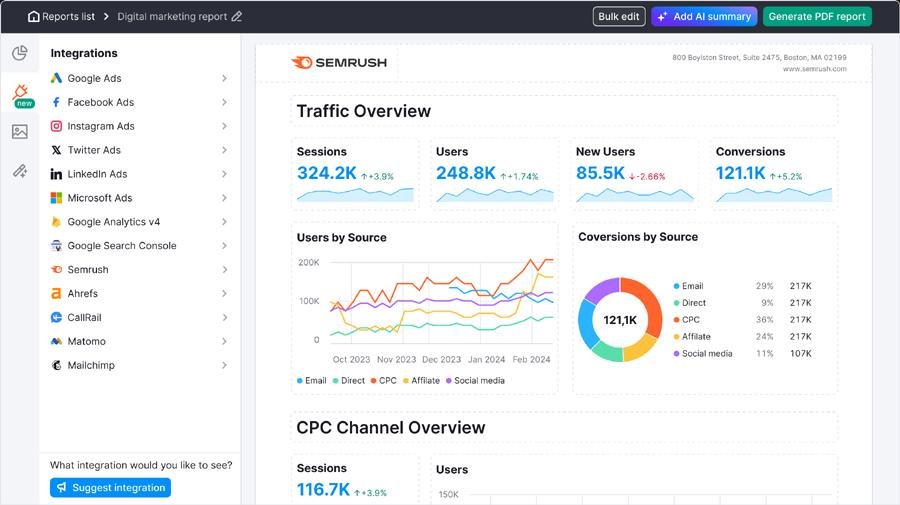
Reporting & integrations — custom PDF/ dashboard reports and connectors to Google Analytics / GSC.
All of that lives inside a single interface — which is both the platform’s strength and what makes the tool feel dense to new users.
Semrush pricing — what to expect in 2026
Semrush runs multiple plan lines (Pro/Guru/Business historically) and recently introduced bundled/AI-centric offerings under Semrush One. Pricing changes often, but expect entry plans in the low-hundreds-per-month and full agency/enterprise plans running multiple hundreds to low thousands per month depending on limits and add-ons. If you need historical data, content features or API access, budget for a mid-tier or higher plan. Always check the official pricing page when you buy.
(Ad)

Semrush Pricing: How Semrush’s 7-Day Free Trial Can Multiply Your ROI to 10X
Who should use Semrush? — practical rules of thumb
Use Semrush if any of the following are true:
You’re managing SEO for more than one site or a site that drives revenue.
You need competitive intelligence (what keywords are competitors winning right now).
Your team produces a steady stream of content and wants to optimize for intent and SERP features.
You run paid search and need to reverse-engineer competitor ad strategies.
If you’re a hobby blogger or an occasional content creator with a tiny budget, Semrush often feels like using a power saw for a craft project — overkill and expensive. For agencies, mid-market brands, and serious in-house teams, it’s a practical central tool.
Recent big news (what changed the market)
Semrush has evolved fast into AI-forward product lines and—important for strategic buyers—was the target of acquisition activity reported in late 2025. That kind of corporate move changes roadmap priorities (AI integrations, cross-product bundles), so keep an eye on official announcements and product updates if long-term vendor stability matters to you.
Semrush vs competitors — the short comparison
Compared to Ahrefs and Moz, Semrush tends to:
Offer broader marketing features (PPC research, social, content tools) vs Ahrefs’ deep backlink data and Moz’s beginner-friendly ease.
Provide richer white-label reporting and an extensive toolset that replaces multiple point solutions — but at higher cost and a steeper learning curve.
Pick Ahrefs if backlinks are your single priority; pick Semrush if you want a central marketing intelligence platform that covers SEO and paid/ content workflows.
Real benefits — what teams actually get
Faster audits & prioritization — cuts the hours you’d spend manual-checking technical issues.
Competitor clarity — you can spot low-effort keyword opportunities and pages worth emulating.
Content velocity — Content templates + Topic Research shorten briefs and improve first drafts.
Cross-channel view — seeing organic and paid overlap helps you avoid keyword cannibalization and plan smarter bids.
I’ve seen teams convert a single competitive insight into a campaign that moves organic traffic within weeks — but that requires acting on the data, not just reading it.
Downsides & practical limits
Price: it’s not cheap for teams; limits (tracked keywords, API calls) bite if you scale.
Learning curve: the UI is feature-dense; new users should follow a 2–3 week onboarding plan.
Estimates, not absolutes: traffic and keyword volumes are estimates — validate against your Google Search Console and Analytics.
Feature creep: as Semrush adds AI features, you’ll need to evaluate whether new additions truly solve your problems or just add noise.
How to test Semrush without wasting money
Start with a short trial. Export a few reports and compare them to your GA/GSC data.
Run a 30-day pilot on one use case (e.g., technical audit + content optimization) and measure traffic or ranking movement.
Use the API limits test if you need automation — export via API and test scripts before you buy a high-limit plan.
Compare with a cheaper tool for that pilot: if a cheaper tool gives 80% of the value, you may not need the full platform.
Quick checklist — is Semrush right for you?
Need multi-site management, deep competitor research or combined organic/paid insights → Yes
Only occasional keyword lookups and basic analytics → Probably not yet
Agency or team that must produce repeatable SEO/ content reports → Strong yes
FAQs (short)
Q: Is Semrush only for SEO?
No — it covers SEO, PPC, content marketing, social and market intelligence.
Q: Can I trust Semrush data?
Yes for trends and signals; always cross-check critical numbers with your Google Search Console and Analytics.
Q: Does Semrush help with AI search / generative rankings?
Semrush has added AI-visibility features and tools to measure presence in AI contexts — check the product roadmap for the latest capabilities.
Final thought
Semrush is a heavyweight platform for teams that need data-driven SEO, content and paid search decisions. It rewards disciplined use: set one measurable pilot, instrument it properly, and evaluate cost per lead or traffic impact after 60–90 days. If you want, I can draft a 30-day Semrush pilot plan (audit checklist, content experiment, KPI tracking sheet) you can run with your team — tell me the site size and goals and I’ll make it actionable.
Now loading...